Four points for digestive comfort.
A simple self-acupressure routine using Yintang (EX-HN3), Neiguan (PC6), Zhongwan (CV12) and Zusanli (ST36).
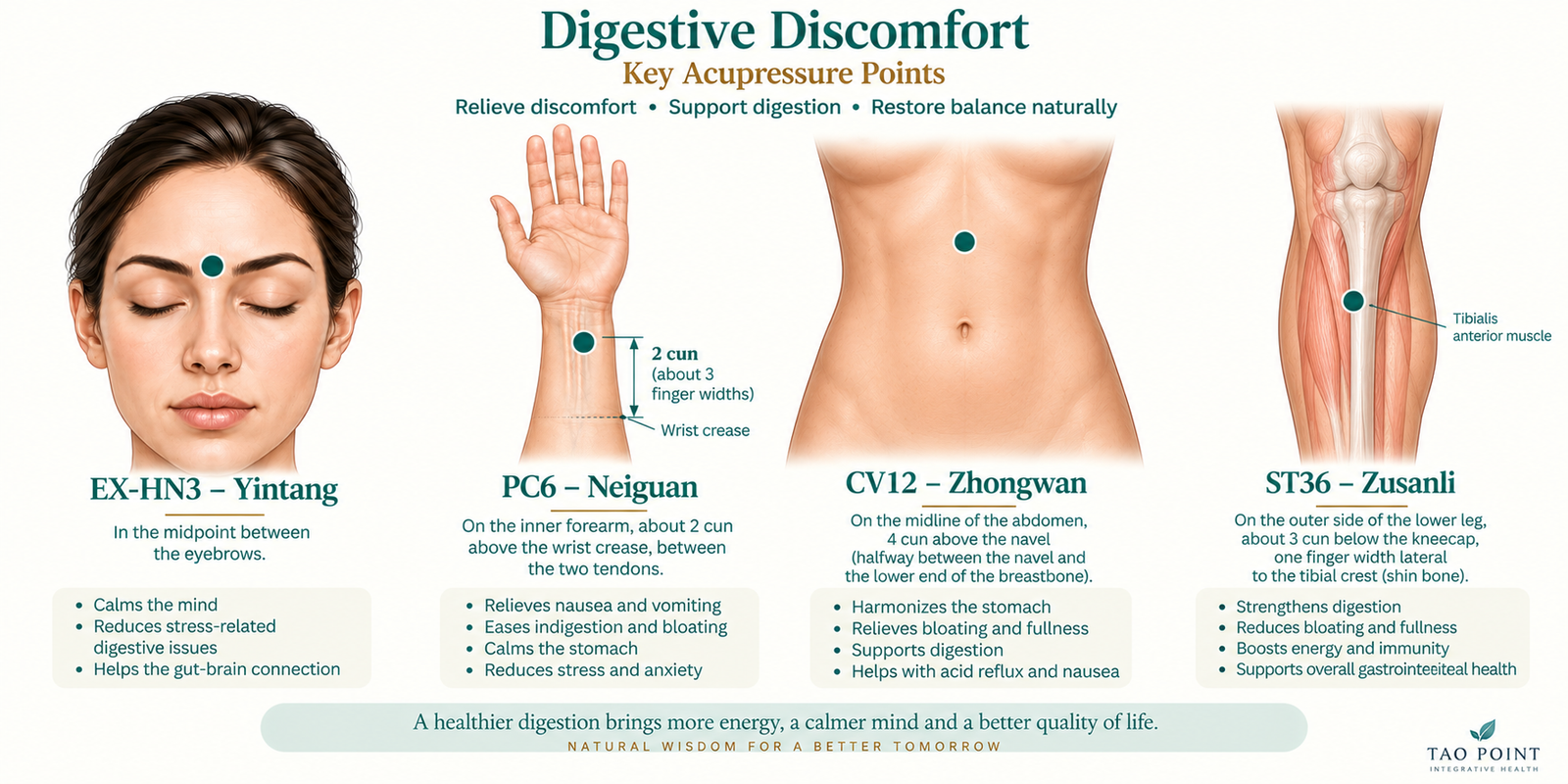
Digestive discomfort has many possible causes.
Bloating, fullness, nausea and general digestive discomfort can occur for many reasons. This Golden Tip is a complementary self-care routine and is not intended to diagnose or treat the underlying cause.
Use comfortable pressure and avoid pressing an abdomen that is acutely painful or tender. Stimulation should feel firm but tolerable, never sharply painful.
Find it. Press it. Breathe.
These instructions use finger pressure only — never needles.
Between the eyebrows
Where
At the midpoint between the medial ends of the eyebrows.
How
Apply gentle steady pressure or small circular massage for 30–60 seconds while breathing slowly.
Traditional use
Traditionally used as a calming point. Here it is included as the relaxation component of the routine.
Inner forearm
Where
On the inner forearm, approximately 2 cun above the wrist crease, between the two prominent flexor tendons.
How
Press with the opposite thumb for 30–60 seconds, then change arms.
Traditional use
Traditionally used for nausea and discomfort involving the stomach and chest.
Upper abdomen
Where
On the midline of the upper abdomen, approximately 4 cun above the center of the navel.
How
When the abdomen is comfortable and not tender, use gentle circular finger pressure for 30–60 seconds. Do not press forcefully.
Traditional use
A major traditional point associated with the Stomach and middle Jiao and commonly used in digestive point combinations.
Below the knee
Where
On the anterolateral lower leg, approximately 3 cun below ST35 and one finger-breadth lateral to the anterior crest of the tibia, over the tibialis anterior region.
How
Massage with the thumb for 30–60 seconds, then repeat on the opposite leg.
Traditional use
One of the best-known points in Chinese medicine, traditionally used in many patterns involving the Stomach, digestion and general support.
About four minutes.
Stop if stimulation causes pain, dizziness, nausea that worsens, skin irritation or unusual discomfort.
Supportive self-care without promising a cure.
Acupuncture and acupressure have been studied for several gastrointestinal symptoms, but evidence differs by condition, point combination and technique. Tao Point presents these points as a complementary routine that may support comfort for some people, not as a substitute for diagnosis or medical treatment.
Know when abdominal symptoms need medical attention.
Do not use acupressure to delay urgent care.
Seek medical evaluation for severe or rapidly worsening abdominal pain, a rigid or markedly tender abdomen, persistent vomiting, blood in vomit or stool, black stools, significant dehydration, high fever, fainting, unexplained weight loss, or other concerning symptoms.
Avoid direct abdominal pressure over recent surgery, injury or another area your healthcare professional has told you not to manipulate.
Back to the self-care library
Choose another common problem and learn a small set of easy-to-locate points.