Four points for a calmer bedtime.
A simple self-acupressure routine using Yintang (EX-HN3), Fengchi (GB20), Neiguan (PC6) and Yongquan (KI1).
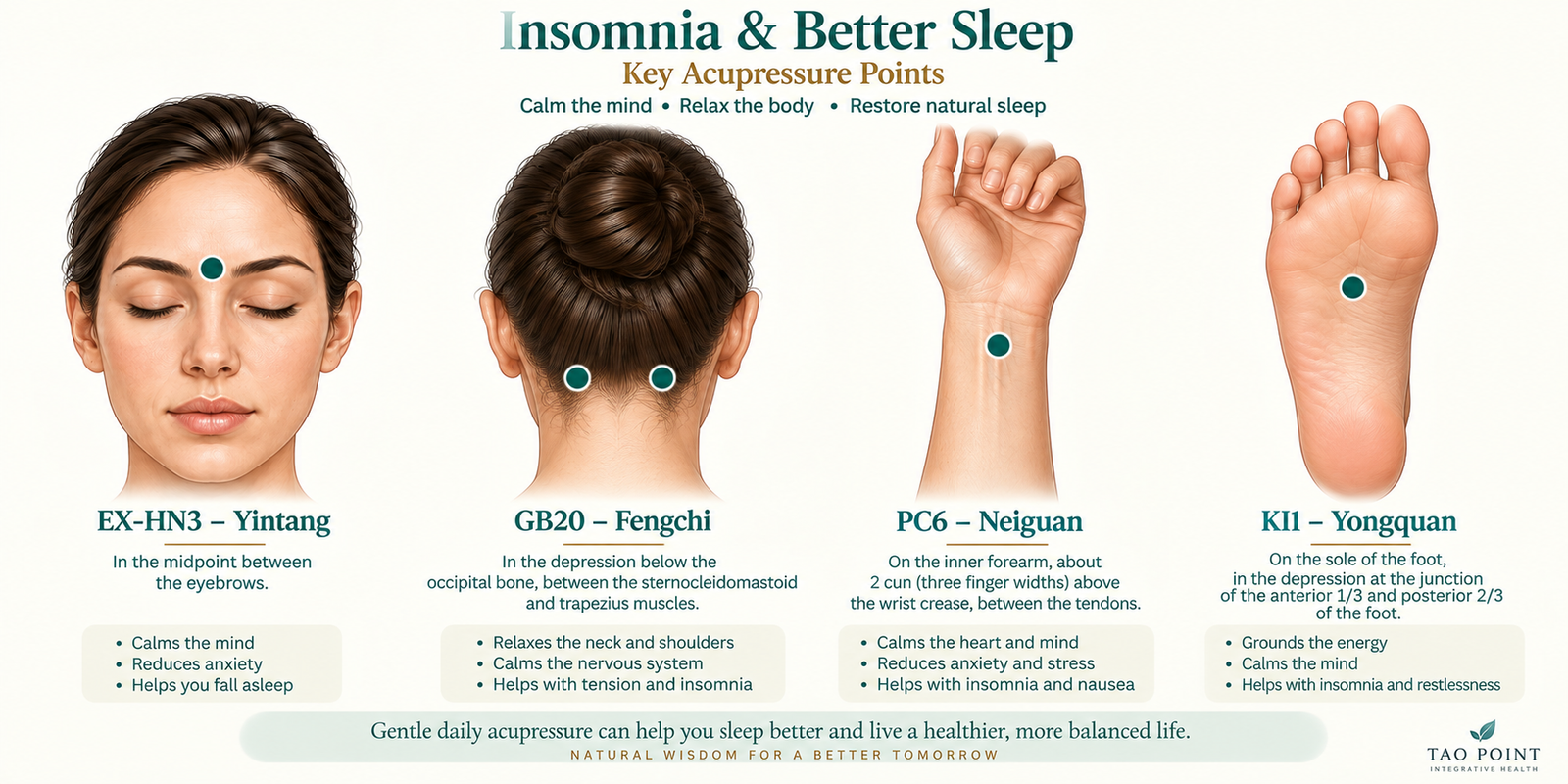
Prepare the body for rest.
Difficulty falling or staying asleep can have many causes. This Golden Tip is a gentle complementary routine intended for relaxation before bedtime, not a treatment for an underlying sleep disorder.
Use slow, comfortable pressure while breathing naturally. Stimulation should feel relaxing, never sharply painful.
Find it. Press it. Slow down.
These instructions use finger pressure only — never needles.
Between the eyebrows
Where
At the midpoint between the medial ends of the eyebrows.
How
Apply gentle steady pressure or small circular massage for 30–60 seconds while breathing slowly.
Traditional use
Traditionally used as a calming point and for symptoms involving restlessness and the head.
Below the base of the skull
Where
In the depressions below the occipital bone, between the sternocleidomastoid and trapezius muscles.
How
Support the head and press gently upward with the thumbs for 30–60 seconds. Avoid forceful pressure.
Traditional use
Commonly used for tension involving the head and neck and as part of relaxation-oriented point combinations.
Inner forearm
Where
On the inner forearm, about 2 cun above the wrist crease, between the two prominent flexor tendons.
How
Press with the opposite thumb for 30–60 seconds, then change arms.
Traditional use
Traditionally associated with calming the Shen and regulating discomfort involving the chest and stomach.
Sole of the foot
Where
On the sole, in the depression that appears in the front portion of the foot when the toes are flexed.
How
Massage each foot with the thumb for 30–60 seconds using comfortable circular pressure.
Traditional use
Traditionally used in patterns involving agitation and to direct attention and activity downward.
About four minutes.
Stop if stimulation causes pain, dizziness, numbness, skin irritation or feels distinctly uncomfortable.
Relaxation support, not a substitute for sleep care.
Acupressure and acupuncture have been studied in relation to sleep quality and insomnia, but study methods and results vary. Tao Point presents this routine as complementary self-care that may support relaxation for some people, without claiming that these points cure insomnia.
Persistent sleep problems deserve attention.
Seek professional evaluation when appropriate.
Talk with a qualified healthcare professional if sleep difficulty is persistent, significantly affects daytime functioning, occurs with breathing interruptions during sleep, or accompanies other concerning physical or psychological symptoms.
Back to the self-care library
Choose another common problem and learn a small set of easy-to-locate points.