Three points to slow things down.
A simple self-acupressure routine using Yintang (EX-HN3), Neiguan (PC6) and Shenmen (HT7).
A short pause for body and mind.
Stress is a normal human response, but persistent or overwhelming stress can affect sleep, concentration and physical wellbeing. This Golden Tip is a complementary relaxation routine, not a treatment for an anxiety disorder or another medical condition.
Use slow, comfortable pressure while breathing naturally. Stimulation should feel firm but pleasant, never sharply painful.
Find it. Press it. Breathe.
These instructions use finger pressure only — never needles.
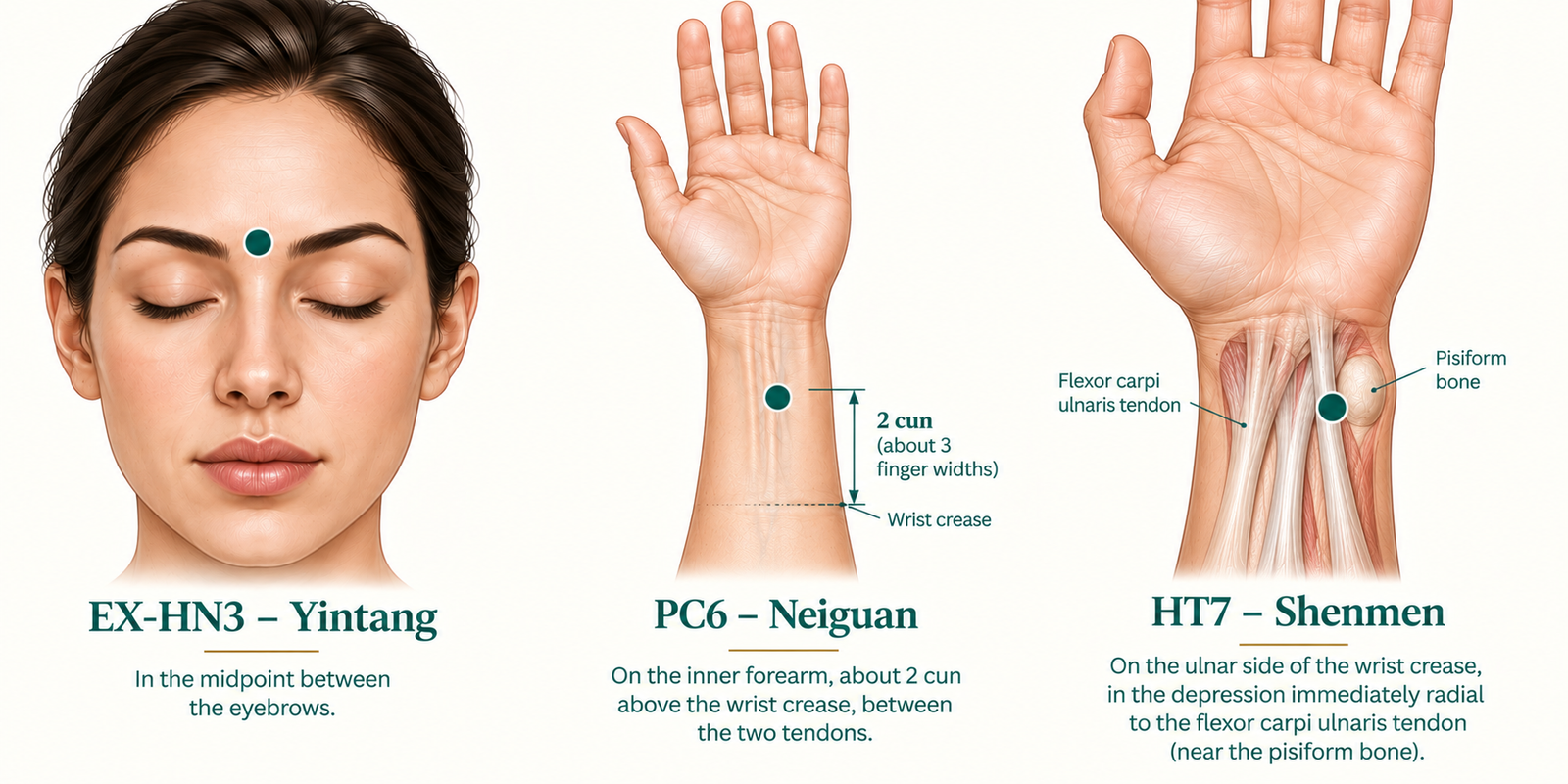
Between the eyebrows
Where
At the midpoint between the medial ends of the eyebrows.
How
Apply gentle steady pressure or small circular massage for 30–60 seconds while breathing slowly.
Traditional use
Traditionally used as a calming point for restlessness and discomfort involving the forehead and head.
Inner forearm
Where
On the inner forearm, approximately 2 cun above the wrist crease, between the two prominent flexor tendons.
How
Press with the opposite thumb for 30–60 seconds, then change arms.
Traditional use
Traditionally associated with calming the Shen and regulating sensations involving the chest and stomach.
Little-finger side of the wrist
Where
On the palmar wrist crease, in the depression immediately radial to the flexor carpi ulnaris tendon, near the pisiform bone.
How
Use the opposite thumb to apply gentle pressure for 30–60 seconds, then repeat on the other wrist.
Traditional use
Shenmen means “Spirit Gate” and is traditionally used in point combinations intended to calm the Shen.
About three minutes.
Stop if stimulation causes pain, dizziness, numbness, skin irritation or unusual discomfort.
Relaxation support without exaggerated claims.
Acupressure and acupuncture studies have included Yintang, PC6 and HT7 in protocols addressing stress-related symptoms, anxiety and sleep. Results vary by population and technique, and evidence for a particular three-point self-acupressure routine is more limited. Tao Point therefore presents this as a simple complementary relaxation practice rather than a treatment for a psychiatric or medical disorder.
Know when stress needs more than self-care.
Persistent or severe symptoms deserve professional attention.
Seek appropriate professional help when anxiety or stress is persistent, significantly interferes with daily life or sleep, causes severe physical symptoms, or is accompanied by thoughts of self-harm or immediate danger.
Back to the self-care library
Choose another common problem and learn a small set of easy-to-locate points.